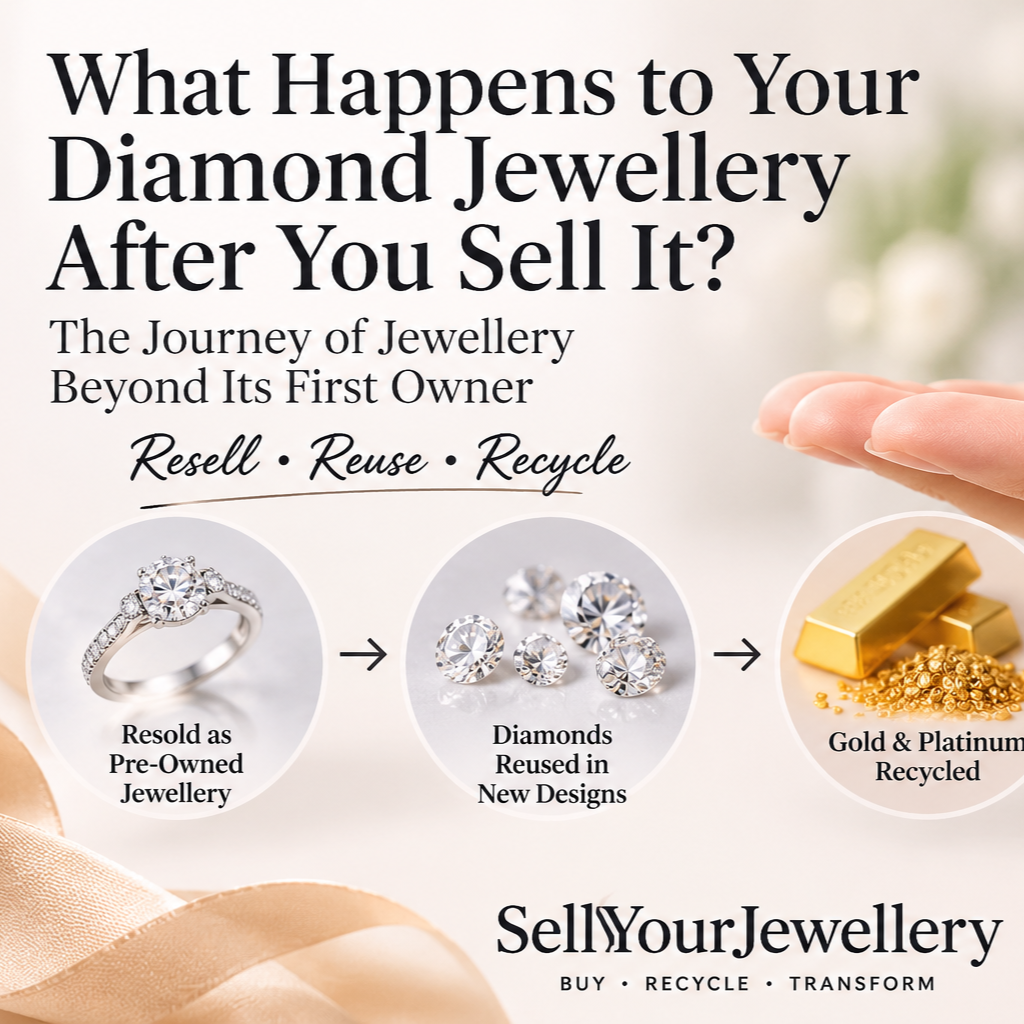
Have you ever wondered what happens to your diamond ring, gold necklace, or inherited jewellery after you sell it?
For many people, selling jewellery is a personal decision. A piece may have been purchased years ago, received as a gift, inherited from a family member, or simply left unworn in a jewellery box.
But what happens after that piece changes hands?
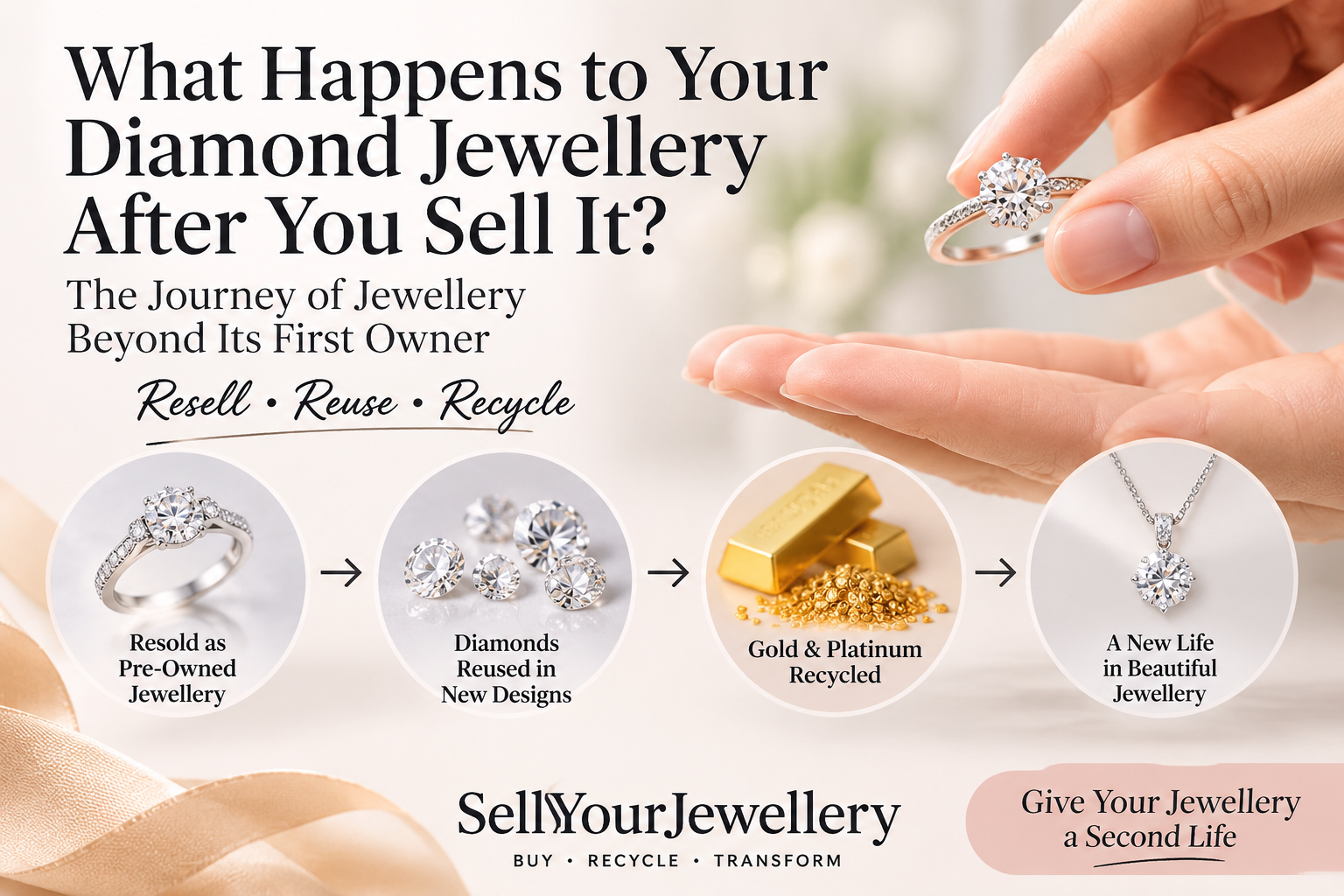
At SellYourJewellery, we believe that jewellery deserves a second life whenever possible. Some pieces are resold and continue their journey as beautiful pre-owned jewellery. Others are carefully dismantled, allowing their diamonds and precious materials to be reused. Gold and platinum can be melted and recycled, while suitable diamonds can be incorporated into new designs.
As part of Dianoche Pte Ltd, a jewellery company with diamond manufacturing expertise, we understand the value of looking beyond the original design.
Every piece has its own story, and every piece deserves to be evaluated individually.
Before You Sell: Should You Keep, Pass On, Reuse, or Sell Your Jewellery?
Before discussing what happens to jewellery after it is sold, we believe there is an even more important question:
Should you sell your jewellery in the first place?
Selling jewellery can be a practical financial decision. Perhaps you need money for an important reason, are preparing for a new chapter in life, or would prefer to turn something you no longer use into something more useful.
There is absolutely nothing wrong with that.
However, jewellery can also carry a meaning that goes far beyond its monetary value.
Before selling a piece, we encourage people to consider a few things.
1. Do you genuinely need the money?
If you have jewellery that you no longer wear and you need money for something important, selling it may be a sensible decision.
An unused diamond ring or gold bracelet can represent a valuable asset that you can put to better use.
Jewellery is meant to be enjoyed, but it can also serve a practical purpose when circumstances change.
2. Does the jewellery have sentimental value?
- Was the ring given to you by someone important?
- Does it remind you of a parent, grandparent, or another loved one?
- Is it part of your family's history?
If the jewellery carries a strong emotional connection, you may want to consider keeping it, even if you no longer wear it.
Sometimes the value of a piece is not reflected in its diamond quality, gold weight, or market price.
3. Is it a family heirloom?
Some jewellery has been passed down through several generations.
An engagement ring worn by a grandmother, a gold necklace received by a mother, or a diamond pendant that has been in the family for decades may carry a story worth preserving.
In these cases, selling the entire piece may not be the only option.
You might consider:
- Passing it to a child or another family member.
- Keeping the original jewellery as a family heirloom.
- Reusing the diamonds or gemstones in a new design.
- Preserving part of the original setting or incorporating meaningful details into a new piece.
A family heirloom does not necessarily need to remain exactly as it was originally made. Sometimes, transforming it into something that can be worn and appreciated by the next generation is the best way to preserve its story.
4. Could you create something new from it?
If you love the diamonds but no longer like the original design, you may not need to sell the jewellery at all.
A dated ring could become a contemporary pendant. A pair of inherited diamond earrings could be transformed into a new pair of earrings or a necklace.
With professional jewellery design and manufacturing, it is possible to preserve the original stones while creating something that better reflects your personal style.
At Dianoche, we work with both traditional jewellery-making techniques and modern design and modelling methods to create bespoke jewellery.
Sometimes, the best decision is not to sell your jewellery, but to give it a new life while keeping its sentimental value.
What Happens to Jewellery After SellYourJewellery Purchases It?
When someone sells jewellery to SellYourJewellery, the next step depends on the individual piece.
We do not treat every ring, necklace, or bracelet in the same way.
A beautiful piece of pre-owned jewellery may deserve to remain intact. A diamond may be suitable for reuse in a new design. A gold setting may be better suited to recycling.
The process begins with evaluating the jewellery and understanding its characteristics, condition, and potential.
Here are the different paths a piece may take.
1. Some Jewellery Finds a New Owner
One of the most sustainable possibilities is that the jewellery does not need to be dismantled at all.
Some pieces are in excellent condition, barely worn, or even unworn. Others have exceptional craftsmanship, distinctive designs, or historical and vintage characteristics that make them attractive to another buyer.
When jewellery is suitable for resale as a complete piece, it can continue its journey with a new owner.
This is one of the advantages of the pre-owned jewellery market.
A ring that no longer suits one person's taste may be exactly what another person is looking for. A vintage necklace may appeal to someone who appreciates traditional craftsmanship. A classic diamond bracelet may become a treasured gift. A previously owned engagement ring may begin an entirely new love story.
By allowing suitable jewellery to be resold, its original craftsmanship and materials can continue to be appreciated.
Not every piece needs to be melted down or dismantled. Sometimes, the most valuable thing we can do is simply give it another opportunity to be worn.
2. Diamonds Can Begin a New Journey
Diamonds are among the most durable materials used in jewellery.
A natural diamond can remain beautiful for generations when properly cared for. This makes it possible for suitable diamonds to be reused in different jewellery designs.
After purchasing a diamond piece, we assess the stones individually.
Depending on their characteristics and market demand, diamonds may be:
- Resold as loose diamonds.
- Reused in newly manufactured jewellery.
- Incorporated into bespoke jewellery designs.
- Reused as smaller diamonds in suitable settings.
The diamond's size, quality, condition, and suitability for a particular application all influence its next destination.
What about small diamonds?
This is an area where diamond manufacturing expertise becomes particularly valuable. Many jewellery pieces contain numerous small diamonds, sometimes referred to as melee diamonds.
These stones may be set into eternity rings, bracelets, earrings, or decorative jewellery designs.
A small diamond may not have the same resale market as a large solitaire diamond, but that does not automatically mean it has no further use.
With the right manufacturing capabilities, suitable small natural diamonds can be recovered and reused in new jewellery.
At SellYourJewellery, we specialise in evaluating diamonds of different sizes, including smaller diamonds that may otherwise be overlooked.
The goal is to recognise the potential of the individual stones rather than assume that every diamond must follow the same path.
3. Gold and Platinum Are Recycled
Unlike jewellery that can be resold as a complete piece, some gold and platinum jewellery is better suited to material recycling.
When a ring, bracelet, or necklace is no longer suitable for resale, its precious metal can be recovered.
The process generally involves separating the metal from other materials, melting and refining it, and preparing it for reuse.
Gold and platinum can then be used in the production of new jewellery or other suitable applications.
This means that the precious metal in an old ring does not necessarily disappear when the original jewellery is dismantled.
It can become part of a completely different piece.
An old gold bracelet might eventually contribute to a new gold ring. A platinum setting may be refined and reused in another jewellery application.
The original design may no longer exist, but the material can continue to have value.
Why does this matter?
Gold and platinum are finite natural resources.
Recycling existing precious metals can reduce the need to rely entirely on newly mined materials.
However, recycling is not impact-free. Collection, refining, processing, and manufacturing all require resources.
The important point is that precious metals can be recovered and reused, helping reduce material waste and supporting a more circular approach to jewellery production.
4. The Difference Between Recycling and Reusing
These two processes are often confused, but they are different.
| Reusing jewellery | Recycling jewellery |
| The original piece or its components are used again. | The material is recovered and processed for reuse. |
| A ring may be resold to another owner. | A gold ring may be melted and refined. |
| A diamond may be removed and set into a new design. | Precious metal is processed into material suitable for manufacturing. |
| Preserves more of the original piece. | Changes the original form of the material. |
Both approaches can contribute to reducing waste.
The decision depends on the jewellery itself, its condition, the materials, and whether it can be given a meaningful second life. Whenever a piece can be resold or its components reused appropriately, that may be preferable to dismantling the entire item.
5. From Old Jewellery to New Jewellery: The Dianoche Connection
SellYourJewellery is part of Dianoche Pte Ltd, a company involved in diamond manufacturing and jewellery production.
This connection allows us to look at jewellery from more than one perspective. We understand the process of evaluating jewellery for resale, but we also understand how diamonds and precious metals can be used in manufacturing. A diamond that is suitable for a new setting has potential beyond its original ring.
A recovered precious metal may become part of a future manufacturing process. A distinctive pre-owned piece may be more valuable when preserved in its original form than when dismantled.
This is why we believe the journey of jewellery should not be determined by a single rule.
The right decision depends on the individual item. Our combination of jewellery buying, diamond expertise, recycling, and manufacturing allows us to recognise different possibilities for the pieces we evaluate.
6. Is Selling Pre-Owned Jewellery a More Sustainable Choice?
The jewellery industry, like many industries that rely on natural resources, faces questions about resource use and environmental impact.
Pre-owned jewellery offers one way to make use of materials and craftsmanship that already exist. When a piece is resold, it can continue to be worn without requiring the creation of an entirely new piece. When diamonds are reused, they can be incorporated into new designs without needing to be newly mined.
When gold and platinum are recycled, existing precious metals can be recovered for further use. These practices can help reduce material waste and extend the useful life of jewellery. It is important not to suggest that every pre-owned purchase has the same environmental benefit or that recycling eliminates all environmental impact.
The value lies in making better use of existing resources. Jewellery can be beautiful, valuable, and meaningful for a very long time. Its story does not have to end with its first owner.
7. What Should You Consider Before Selling Your Jewellery?
If you are considering selling jewellery in Singapore, we recommend taking a moment to think about the decision.
Ask yourself:
- Do I need the money for something important?
- Have I worn this jewellery in recent years?
- Does the piece have sentimental or family significance?
- Could someone in my family appreciate it?
- Would I prefer to reuse the diamonds or create a new design?
- Am I comfortable parting with the original piece?
There is no universally correct answer.
For some people, selling unused jewellery is the right decision. For others, keeping a family heirloom or transforming it into a new design may be more meaningful. And sometimes, the decision is a combination of both. You may choose to keep one special piece, pass another to a family member, and sell jewellery that no longer serves a purpose in your life.
The important thing is to make an informed decision.
How SellYourJewellery Gives Jewellery a Second Life
At SellYourJewellery, we believe that jewellery should be valued for its full potential. Some pieces deserve to be preserved and resold. Some diamonds can be reused in new jewellery. Gold and platinum can be recovered and recycled.
Every piece is different, and we assess it accordingly. Our connection with Dianoche's diamond manufacturing expertise allows us to understand the possibilities beyond the original design.
We are not simply interested in the jewellery as it is today. We are interested in what it may become. Whether you have an old diamond ring, a gold necklace, an inherited bracelet, or jewellery you no longer wear, we can help you understand its potential value.
If you are considering selling your jewellery, we welcome you to arrange a professional evaluation with SellYourJewellery in Singapore.
And if the piece carries a special meaning, take the time to consider whether selling it is truly the right decision.
Because sometimes the best way to give jewellery a second life is to pass it on. Other times, it is to transform it. And sometimes, it is to let it go.
Whatever you decide, your jewellery's story deserves to be considered.
Frequently Asked Questions
1.What happens to diamond jewellery after I sell it?
The next step depends on the piece. Suitable jewellery may be resold as pre-owned jewellery, while diamonds may be resold loose or reused in new designs. Gold and platinum may be melted, refined, and recycled.
2.Are diamonds from old jewellery reused?
Suitable diamonds can be recovered and reused in new jewellery. Their size, quality, condition, and suitability for manufacturing help determine their next use.
3. What happens to the gold in my old ring?
Gold jewellery that is not suitable for resale may be dismantled and processed for recycling. The recovered gold can be refined and reused in jewellery manufacturing or other applications.
4.Is selling pre-owned jewellery sustainable?
Reselling and reusing existing jewellery can extend its useful life and reduce material waste. Recycling precious metals can also help recover valuable resources. The environmental impact depends on the individual process.
5.Should I sell inherited jewellery?
That depends on its sentimental significance, your financial needs, and whether you would prefer to preserve or pass on the piece. You may also consider reusing its diamonds or other meaningful elements in a new design.
6.Can I reuse the diamonds from my old engagement ring?
In many cases, yes. Suitable diamonds can be removed from an existing ring and incorporated into a new design. A professional assessment can help determine whether the stones are suitable for reuse.
7.Does SellYourJewellery buy jewellery with small diamonds?
Yes. SellYourJewellery evaluates natural diamonds of different sizes, including small diamonds set in jewellery. The final offer depends on the characteristics of the diamonds and the complete piece.
Need an instant quote on your jewellery or diamonds?
Have a similar item to sell?
Receive a non-obligatory cash valuation pegged to live market benchmarks. Message our GIA appraiser directly with your photos or visit our Kreta Ayer showroom.
Sell Your Jewellery Singapore
Official diamond and precious metal buyer in Singapore. Accredited GIA gemologists offering transparent appraisals, spectrometry testing, and immediate PayNow payout.