For many years, natural diamonds were considered a relatively stable luxury purchase. Although their value could vary depending on quality, size and market conditions, owners often expected a well-chosen diamond to retain a meaningful portion of its value over time.
Today, the market looks very different.
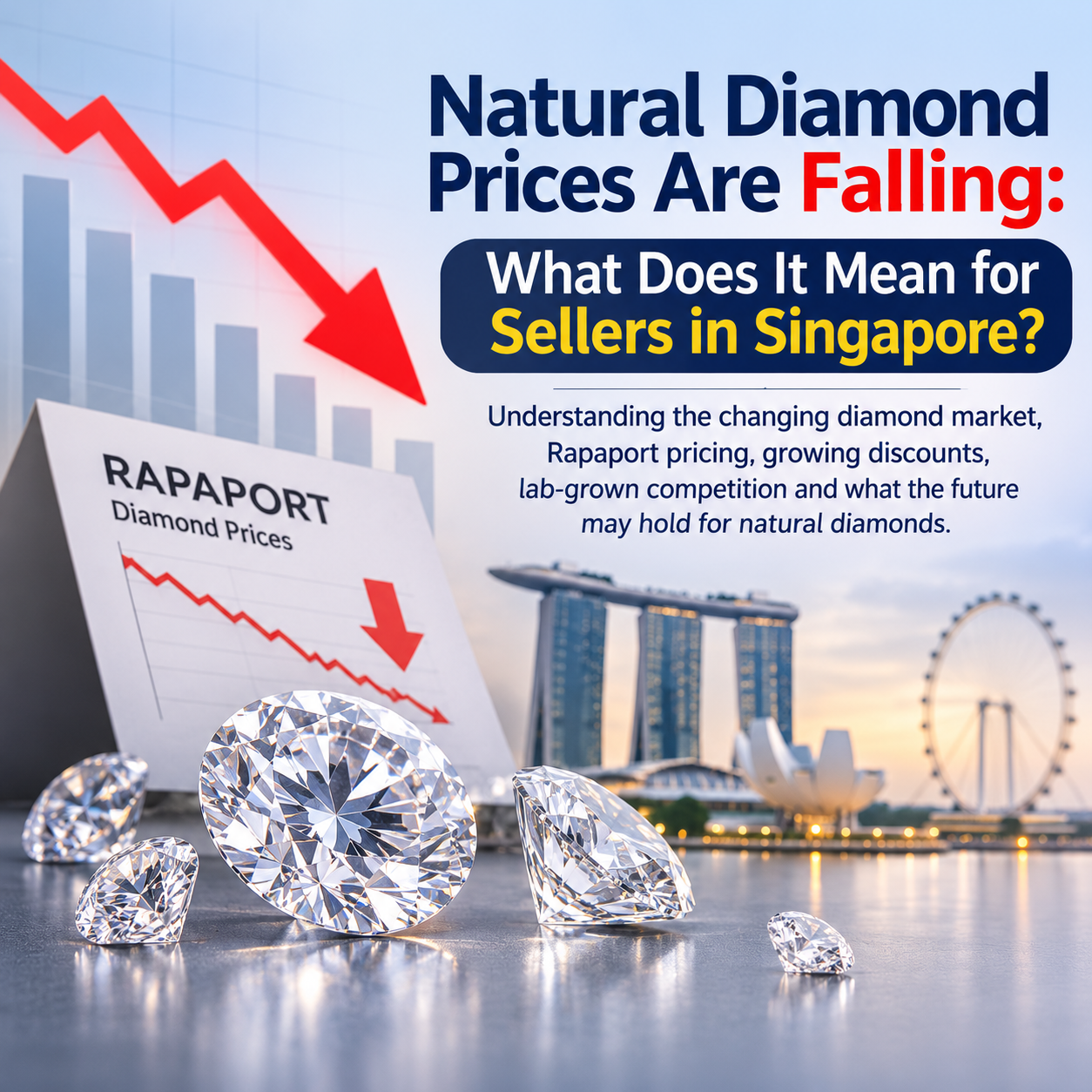
Natural diamond prices have come under considerable pressure. The change is particularly noticeable in smaller round diamonds, while the second-hand market has become more challenging for both sellers and professional jewellery buyers.
But there is an important distinction that many diamond owners may not understand: the decline is not only reflected in published diamond price references. The discounts applied to those references in actual trade transactions also play an important role in determining what a diamond is worth today.
So, what is really happening in the natural diamond market? Why are some diamonds more affected than others? And should owners in Singapore sell their natural diamonds now or consider waiting?
To understand these questions, we spoke with Elad Kirschberg, a diamond industry professional with more than 20 years of experience in diamond manufacturing and trading, to share his perspective on the current market and its possible future direction.
1. The Natural Diamond Market Is Going Through a Major Change
The natural diamond industry is experiencing a period of significant adjustment.
Demand has weakened in several market segments, transactions have become less frequent, and buyers are more selective about the diamonds they purchase. At the same time, lab-grown diamonds have introduced a new competitive force, particularly in the more affordable diamond categories.
These changes affect the entire supply chain, from manufacturers and wholesalers to jewellery retailers and owners looking to sell pre-owned diamond jewellery.
However, it is important not to treat all diamonds as if they are part of the same market. A small commercial-quality round diamond and a large, rare fancy-shaped diamond can experience very different market conditions.
Understanding these differences is essential when evaluating a natural diamond today.
2. Why Are Natural Diamond Prices Falling?
There is no single reason behind the decline. Several factors are influencing the market at the same time.
- Lower consumer demand
When consumers purchase fewer natural diamonds, the effect eventually reaches manufacturers, wholesalers and the secondary market.
According to Elad Kirschberg, one of the most noticeable changes is the reduction in demand and the number of transactions taking place.
When fewer buyers are actively looking for diamonds, sellers have fewer opportunities to achieve the prices they might have expected in previous years.
- Competition from lab-grown diamonds
Lab-grown diamonds have changed the way consumers approach diamond purchases.
They offer the appearance and physical properties of diamonds at substantially lower retail prices. For some consumers, particularly those who prioritise size and appearance within a specific budget, lab-grown diamonds have become an attractive alternative.
This competition has placed additional pressure on certain natural diamond categories.
- A more cautious trading environment
When demand is uncertain, businesses become more selective about the inventory they hold.
Manufacturers, wholesalers and jewellery buyers must consider how easily a diamond can be resold, how long it may remain in stock and whether there is an existing customer for that particular stone.
This can make it harder for sellers to receive strong offers, even when their diamonds are natural and in good condition.
3. Rapaport Is Not the Same as the Price You Will Receive
One of the most common misunderstandings among diamond owners is the assumption that a published diamond price list represents the amount they can expect to receive when selling their diamond.
It does not.
Rapaport is an important industry price reference used by diamond professionals. However, it should not be confused with the actual transaction price of an individual diamond.
In practice, diamonds are frequently traded at discounts to the published reference prices. The size of the discount depends on several factors, including:
- Diamond shape and carat weight.
- Colour, clarity and cut quality.
- Overall appearance and visual performance.
- Current demand for that particular category.
- Availability of comparable diamonds in the market.
- The buyer’s existing inventory and resale opportunities.
There are therefore two separate factors that can affect a diamond’s market value.
First, the underlying reference prices may decline. Second, the actual trading price may be further reduced by the discount applied to that reference.
This distinction helps explain why the amount a seller receives today can be significantly different from what they might have expected based on an older price reference or the original purchase price.
It also explains why two diamonds with similar specifications may receive different offers from professional buyers.
4. Why Are Round Diamonds Below One Carat Particularly Affected?
Not every diamond category is experiencing the same level of pressure.
Based on Elad’s observations of the current market, round diamonds of one carat or less are among the categories facing the greatest challenges.
These diamonds are widely available in the market and are often purchased for commercial jewellery production. They also compete directly with lab-grown alternatives, which can offer consumers a larger-looking stone at a lower retail price.
When demand weakens in this segment, buyers become more cautious and the resale market becomes increasingly competitive.
This is particularly relevant for owners of smaller diamond jewellery.
For example, a ring containing several smaller round diamonds may not receive the same level of interest as a ring featuring a larger centre diamond. The total carat weight alone does not determine its resale value.
The individual stones, their quality, their size and the possibility of reusing or reselling them all matter.
5. Are Larger and Fancy-Shaped Diamonds More Resilient?
While smaller round diamonds are under considerable pressure, some other categories appear to be holding up relatively better.
Elad believes that larger diamonds and non-round shapes can benefit from more limited availability in certain segments.
Fancy shapes include diamonds such as:
- Oval.
- Pear.
- Emerald cut.
- Cushion.
- Radiant.
- Marquise.
- Heart shape.
These diamonds are not automatically more valuable or easier to sell than round diamonds. Their marketability still depends on quality, proportions, appearance and consumer demand.
However, certain larger or less commonly available stones can have a different supply-and-demand profile from standard commercial round diamonds.
Rare natural coloured diamonds can occupy an even more specialised market. Pink, blue, green and particularly rare yellow diamonds may attract collectors and buyers interested in rarity rather than simply carat weight.
It is important to distinguish between rarity and guaranteed resale value. A rare diamond still needs an appropriate buyer, and its value must be assessed individually.
6. How Lab-Grown Diamonds Are Changing Consumer Behaviour
The growing popularity of lab-grown diamonds is one of the biggest changes Elad has witnessed during his career.
For younger consumers, the decision is increasingly about appearance, budget and personal priorities. Some buyers are comfortable choosing a lab-grown diamond rather than paying more for a natural stone.
This shift has created additional pressure on natural diamonds, especially in categories where consumers are more price-sensitive.
However, Elad’s experience with Dianoche’s own customers presents another perspective.
In his customer base, particularly among buyers aged 30 and above, there remains a strong preference for natural diamonds. Many customers specifically request natural stones and are not interested in lab-grown alternatives.
This illustrates an important point: the market is changing, but consumer preferences are not uniform.
Natural and lab-grown diamonds serve different purchasing motivations. Some customers prioritise affordability and size, while others place importance on natural origin, rarity and the individual character of a natural gemstone.
What about the resale value of lab-grown diamonds?
From Elad’s experience in the secondary diamond market, lab-grown diamonds currently have very limited resale opportunities and can lose almost all of their original retail value when owners attempt to sell them.
This is an important consideration for consumers who are comparing the initial purchase price of natural and lab-grown diamonds.
A lower purchase price does not necessarily mean that a diamond will have a stronger resale market. Anyone purchasing a diamond should understand whether they are buying primarily for personal enjoyment or with the expectation of retaining resale value.
7. Why Is the Second-Hand Diamond Market Facing Even Greater Challenges?
The pressure on natural diamond prices has a direct impact on the second-hand jewellery market.
For sellers, the difference between what they originally paid and what they can receive today may be particularly disappointing.
But there is another side to the issue: professional jewellery buyers are also facing greater challenges when purchasing pre-owned diamonds. A buyer must consider whether a diamond can be resold, whether there is demand for its particular characteristics and how much time and capital may be required before it finds another owner.
When fewer customers are purchasing natural diamonds, there are fewer opportunities to resell them.
This means buyers may need to be more selective when making offers.
For someone selling jewellery, this can result in fewer available buyers and less competition for the item.
The situation becomes especially difficult for owners who need immediate cash or simply want to clear jewellery they no longer use. In these circumstances, the highest available offer may be the most practical option, even if it is below their original expectations.
At SellYourJewellery, we believe it is important for sellers to understand the market before making a decision. An offer should be evaluated based on the complete jewellery piece, its diamonds, its precious metals and its realistic resale or reuse potential.
8. What Could Happen to Natural Diamond Prices in 2027 and Beyond?
Predicting diamond prices is difficult, particularly during a period of major changes in consumer behaviour and industry structure.
Elad’s personal assessment is that the pace of decline has moderated compared with the earlier stages of the downturn.
He also believes that there may be a limit to how far prices can fall, although this does not mean that a recovery is guaranteed or that all diamond categories will move in the same direction.
One factor he is watching closely is the number of manufacturers remaining active in the natural diamond industry.
If fewer manufacturers continue producing natural diamonds, future supply could become more limited.
Should consumer demand strengthen while available inventory remains constrained, certain natural diamond categories could benefit from renewed price support.
However, this is a possible future scenario, not a certainty. The timing and scale of any recovery will depend on demand, supply, consumer preferences and broader economic conditions.
Need an instant quote on your jewellery or diamonds?
💬 WhatsApp Photos to +65 8904 5966
Could natural diamonds become more valuable again?
Elad believes that some natural diamond categories may have stronger long-term potential than others.
Larger stones, certain fancy shapes and rare coloured diamonds may benefit from limited availability and their appeal to collectors or buyers seeking something distinctive.
He also believes that natural diamonds have become more accessible in some categories following the recent price adjustments. His personal view is that consumers who appreciate natural diamonds may find current market conditions worth considering when making a purchase. Nevertheless, diamonds should primarily be purchased for their beauty, meaning and personal enjoyment. No diamond should be treated as a guaranteed investment.
9. Should You Sell Your Natural Diamond Today or Wait?
There is no universal answer. The right decision depends on the type of diamond you own and your personal circumstances. Elad’s advice is to consider the individual diamond rather than making a decision based on general headlines about the market.
- If you own a round diamond of one carat or less
This category is currently facing significant pressure.
If you do not need the money and are comfortable waiting, Elad’s personal view is that there may be a reason to hold on rather than sell immediately.
He believes a meaningful recovery, if it happens, could take several years. He has suggested that it may take five years or longer before some categories begin to see a stronger upward trend.
This is a personal market outlook, not a prediction that can be guaranteed.
- If you own a larger or fancy-shaped diamond
These categories may have different supply and demand conditions. Rather than assuming that your diamond has followed the same price movement as smaller commercial round stones, it is worth obtaining an individual assessment.
Quality, proportions, shape, condition and marketability can make a substantial difference.
- If you need the money now
Waiting is not always a practical option. If you need immediate funds or no longer want to keep the jewellery, selling may still be the right decision.
The important thing is to have realistic expectations and compare actual offers rather than relying solely on the original purchase price or a published price reference.
10. Why a Professional Valuation Matters More Than Ever
In a changing market, a general estimate based on carat weight or a certificate is not enough.
Two diamonds with the same stated carat weight may have very different resale potential.
A professional evaluation should consider:
- Whether the diamond is natural or lab-grown.
- Its actual colour, clarity and cut characteristics.
- Its proportions and overall visual appearance.
- Whether it has chips, damage or other condition issues.
- Its shape and current market demand.
- Whether it can be resold as a complete piece or reused in manufacturing.
At SellYourJewellery, we combine diamond evaluation, jewellery buying, recycling and manufacturing experience.
This allows us to consider not only the metal value or the published diamond reference price, but also the potential to reuse individual stones or resell a complete jewellery piece.
For sellers, this distinction can matter.
A diamond that is not particularly attractive to one buyer may still have potential for another, depending on that buyer’s inventory, customers and manufacturing capabilities.
We therefore encourage jewellery owners to obtain a professional in-person evaluation and compare the final offers they receive.
Elad Kirschberg’s Final Perspective: The Natural Diamond Market May Be Entering a New Chapter
After more than 20 years in the diamond industry, Elad believes the current market represents one of the most significant changes the industry has experienced. Lab-grown diamonds have changed consumer expectations, demand has weakened in certain natural diamond categories, and the secondary market has become more difficult for both sellers and buyers.
However, he does not believe that every natural diamond should be viewed in the same way. Smaller commercial round diamonds face different challenges from larger stones, unusual shapes and rare coloured diamonds.
His outlook is cautiously optimistic about the possibility of a future recovery, particularly if manufacturing capacity continues to contract and demand eventually strengthens. For owners considering selling their jewellery, his advice is straightforward: understand what you own, understand the market for that particular diamond and make your decision based on your financial needs rather than assumptions about what the diamond originally cost.
The natural diamond market is changing. Knowing the difference between a diamond’s original retail price, its published market reference and its realistic resale value has never been more important.
Frequently Asked Questions
1.Are natural diamond prices still falling?
Natural diamond prices have experienced considerable pressure. However, the impact varies by category, with smaller commercial round diamonds facing particular challenges. Market conditions can change, and a recovery in some categories is possible but not guaranteed.
2.Why is my diamond worth less than its original purchase price?
Retail jewellery prices include more than the value of the loose diamond. They may include design, manufacturing, setting, branding, retail overheads and other costs. The resale market is based on what a buyer can realistically pay and subsequently resell or reuse the item for.
3.Is Rapaport the actual price I can sell my diamond for?
No. Rapaport is an industry price reference, not a guaranteed buying price. Actual transactions may take place at discounts, depending on the diamond’s characteristics and current market conditions.
4.Which diamonds are most affected by the current market?
Based on current industry observations, smaller round diamonds, particularly those of one carat or less, are facing significant pressure. Other categories may have different supply and demand conditions.
5.Do larger diamonds hold their value better?
Some larger diamonds may be more resilient due to their relative scarcity and demand. However, size alone does not determine resale value. Quality, shape, proportions, condition and marketability all matter.
6.Do lab-grown diamonds have resale value?
Based on our experience in the secondary market, lab-grown diamonds currently have very limited resale opportunities compared with natural diamonds. Their resale value can be substantially lower than their original retail price.
7.Should I sell my diamond now or wait?
It depends on the diamond and your financial circumstances. If you need the money, selling may be the practical choice. If you can wait, you may prefer to monitor market conditions. However, no future price recovery is guaranteed.
8.Can I receive an accurate diamond valuation from photographs?
Photographs can help provide an initial indication, but they cannot replace an in-person inspection. A professional evaluation allows the buyer to examine the diamond’s actual quality, condition and characteristics before making a final offer.
Thinking of Selling Your Natural Diamond Jewellery in Singapore?
At SellYourJewellery, we evaluate natural diamond jewellery, loose diamonds and precious metals. Our approach combines professional diamond assessment with jewellery buying, recycling and manufacturing experience.
Whether you have a solitaire ring, diamond earrings, a tennis bracelet or loose natural diamonds, we encourage you to understand the value of your jewellery before making a decision.
Contact SellYourJewellery to arrange a professional evaluation.
Need an instant quote on your jewellery or diamonds?
Have a similar item to sell?
Receive a non-obligatory cash valuation pegged to live market benchmarks. Message our GIA appraiser directly with your photos or visit our Kreta Ayer showroom.
Sell Your Jewellery Singapore
Official diamond and precious metal buyer in Singapore. Accredited GIA gemologists offering transparent appraisals, spectrometry testing, and immediate PayNow payout.