Over the past few weeks, jewellery owners and investors across Singapore have been waking up to the same question: What is happening to the price of gold? After breaking all-time records earlier this year and climbing close to US5,600 per ounce, October and November 2026 have delivered a sharp correction. Spot gold fell roughly 7% in October and another 8% in November, sliding to a 14-month low around US3,515–US$3,555 per ounce.
The impact has been felt immediately on the ground in Singapore. Within a single week, local reference rates dropped by approximately 8.65%, bringing pure 999 (24K) gold to around S201 per gram and 916 (22K) gold to roughly S186 per gram.
Speaking with gold and jewellery sellers at our Singapore atelier every day, I know how unsettling sudden market swings can feel. The current pullback is not random—and understanding the forces behind it is the best way to decide whether to cash in unused jewellery now or hold for the long term.
Need an instant quote on your jewellery or diamonds?
💬 WhatsApp Photos to +65 8904 5966
Key Takeaways
- Why gold is falling: Five macro forces—US Federal Reserve rate-hike fears, near-5% Treasury yields, a 19-month high in the US dollar, equity margin calls, and ETF profit-taking—are pressuring prices simultaneously.
- Short-term outlook (Late 2026–Early 2027): Volatility will centre on the 9 December Fed meeting; major banks including Singapore’s OCBC still forecast a recovery toward US4,150–US4,500 by year-end and US4,650–US5,000 in 2027.
- Long-term fundamentals (2027–2030): Structural support remains intact, anchored by aggressive central bank accumulation (675 tonnes year-to-date) and strong Asian physical demand on dips.
- For Singapore sellers: Even after the correction, local gold prices remain historically elevated compared to two or three years ago.
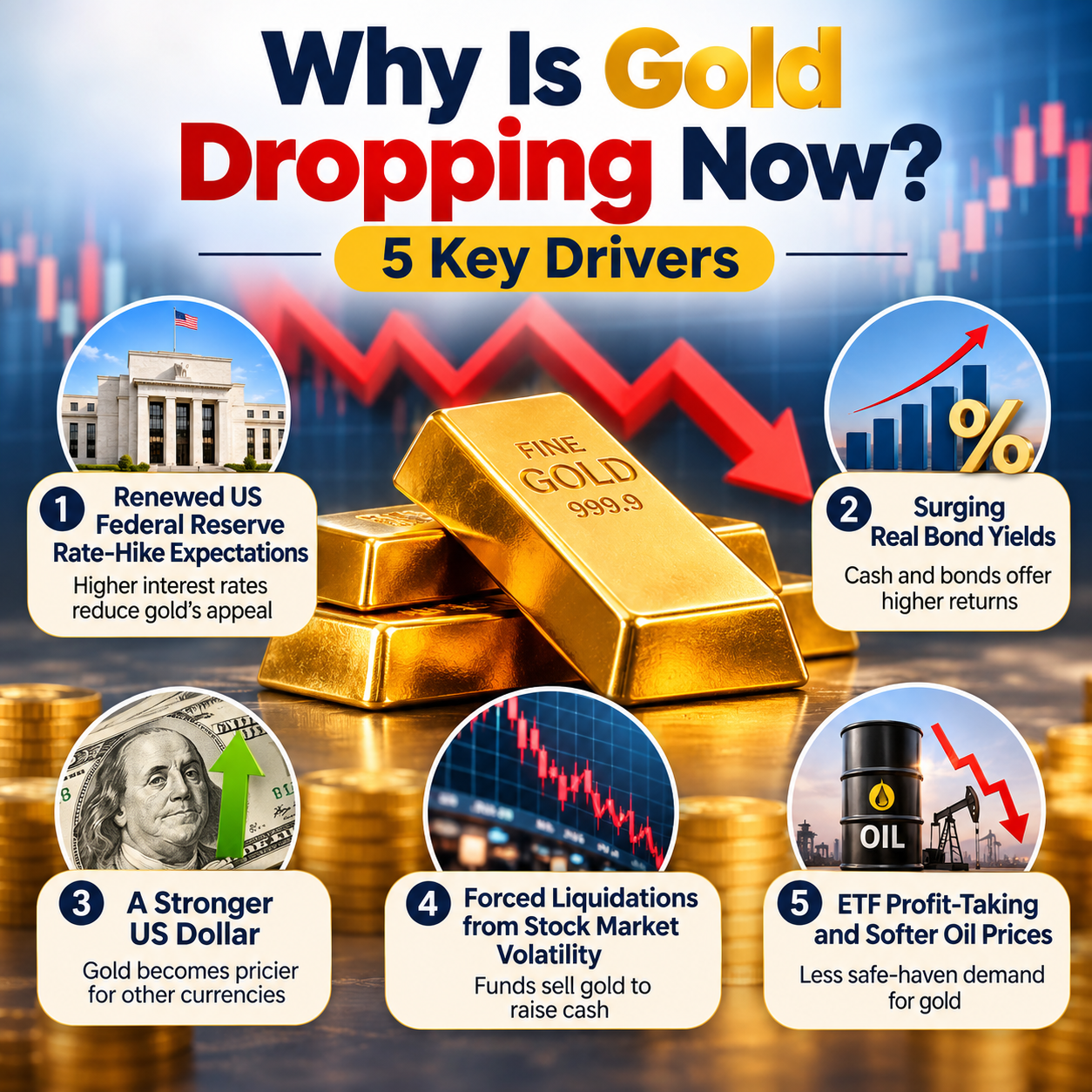
Why Is Gold Dropping Now? 5 Key Drivers
Gold does not move in isolation. November’s sell-off is the result of five macroeconomic pressures colliding at once:
- Renewed US Federal Reserve Rate-Hike Expectations: Sticky US inflation—with October CPI rising 0.4% in a single month—has led markets to price in a near-certain interest rate hike at the Fed’s 9 December meeting, along with expectations of another hike in early 2027. Because gold pays no interest or dividend, rising rates reduce its short-term appeal.
- Surging Real Bond Yields: The 10-year US Treasury yield is approaching 5%, pushing real (inflation-adjusted) yields up toward 2.88%. When cash and government bonds offer high, low-risk returns, the opportunity cost of holding gold rises sharply.
- A Stronger US Dollar: The US Dollar Index has climbed nearly 2% in November, holding near 19-month highs. Because gold is priced globally in US dollars, a stronger greenback makes bullion more expensive for buyers in other currencies—including across Asia—cooling immediate demand.
- Forced Liquidations from Stock Market Volatility: Steep declines in technology and AI stocks, alongside renewed tariff concerns, have triggered liquidity stress across financial markets. During sharp equity sell-offs, funds and traders frequently sell liquid assets like gold to meet margin calls and raise cash.
- ETF Profit-Taking and Softer Oil Prices: Since the late-October peak, gold-backed ETFs have shed roughly 36 tonnes of bullion as institutional investors lock in earlier gains. At the same time, Brent crude oil easing from around US120 in October to roughly US92 has temporarily deflated some of the safe-haven urgency built into gold prices.
Short-Term Outlook (Late 2026 – Early 2027): High Volatility Ahead of the Fed
In the immediate term, the market’s next decisive move hinges on the Federal Reserve’s December decision and its rate projections for 2027. Two primary scenarios are in play:
- Continued Downside Pressure: If the Fed surprises markets with an aggressive 50-basis-point hike or signals a prolonged series of increases into 2027, yields will stay elevated and gold could break below the psychological US$3,500 support level to test lower ground.
- Stabilisation and Technical Rebound: If December brings a measured 25-basis-point hike paired with more dovish guidance for 2027, much of the negative news is already priced in. That could stabilise the market and spark a rebound back toward US$4,000 and above.
Notably, even after revising their near-term figures downward in November, major global financial institutions—including Singapore’s own OCBC Bank—view the current drop as a short-term overshoot rather than a structural breakdown:
| Financial Institution | End-2026 Forecast (per oz) | 2027 Forecast (per oz) | Core Market View |
| Goldman Sachs | US$4,150 | US$4,650 | Near-term caution around the Fed; structurally bullish long term. |
| OCBC (Singapore) | US$4,250 | US$4,710 | Trimmed short-term target, but maintains a positive medium-term outlook. |
| UBS | US$4,500 | US$5,000 | Views the pullback as positioning and liquidity driven, not the end of the bull cycle. |
| J.P. Morgan | ~US$4,500 (Q4) | Up to US$5,000 | Expects temporary pressure in early 2027 followed by renewed upward momentum. |
| Bank of America | ~US$4,000 (Q4 avg) | Around US$5,000 | Most conservative for late 2026, with a steady recovery projected through 2027. |
Long-Term Outlook (2027–2030): Is the Gold Bull Run Over?
The short answer is no—though the path higher will not be a straight line. Beneath the red headlines of recent weeks, gold’s long-term pillars remain remarkably firm:
- Relentless Central Bank Buying: According to World Gold Council data, central banks purchased 321 tonnes of gold in Q3 2026 alone—a 42% jump year-on-year—bringing total official purchases to 675 tonnes year-to-date. China’s central bank, for example, has expanded its gold reserves for 24 consecutive months. Goldman Sachs analysts project official-sector buying to continue at roughly 60 tonnes per month.
- Reserve Diversification and Sovereign Debt: Countries continue diversifying away from single-currency dependence amid wide fiscal deficits and persistent geopolitical friction. Gold’s role as a long-term store of value remains unchanged.
- Asian Physical Demand on Dips: Historically, sharp price corrections trigger renewed physical buying of gold jewellery and bullion across China, India, and Southeast Asia, helping establish a natural demand floor.
Still, realism matters. Institutions such as the World Bank caution that if real interest rates remain elevated over an extended period, gold may consolidate within a US4,000–US4,250 range across 2027–2028 rather than immediately revisiting January 2026’s euphoric peaks. Breaking into fresh record territory between 2028 and 2030 will largely depend on when central banks pivot back to rate cuts and how global geopolitical risks evolve.
Need an instant quote on your jewellery or diamonds?
💬 WhatsApp Photos to +65 8904 5966
What Does This Mean for Gold and Jewellery Owners in Singapore?
In private consultations at our Kreta Ayer Road showroom, many clients worry they have "missed the boat" because of the recent drop. Putting today’s numbers into historical perspective helps clarify the picture:
- Prices Are Still Historically High: Even at roughly US3,550 per ounce (around S186–S$201 per gram in local reference rates), gold remains substantially higher than it was two or three years ago. Anyone who purchased 999, 916, or 18K gold jewellery over the past decade is still sitting on significant gains.
- The Risk of Trying to Time the Exact Peak: Nobody can reliably predict whether gold will drop another 10% in December or rebound sharply. If you have unworn, broken, or inherited jewellery that you plan to turn into cash, waiting passively to catch a fleeting high can expose you to further volatility.
- Spot Gold Is Only One Part of the Payout: When selling jewellery in Singapore, your final offer depends on more than the international spot price. The SGD/USD exchange rate, exact gold purity (karat), precise weight, and—crucially—the added resale value of natural diamonds, coloured gemstones, or signed luxury brands all play a major role beyond simple melt value.
In volatile markets, the smartest move is acting on clear information rather than emotion. Having your pieces professionally assessed gives you an accurate baseline of what they are worth today, allowing you to decide calmly whether to sell part of your collection now or hold onto it for the longer term.
At Sell Your Jewellery (sellyourjewelry.com.sg)—a licensed secondhand goods dealer regulated by the Singapore Police Force and a member of the Diamond Exchange of Singapore—we provide private, transparent, no-obligation valuations at our Kreta Ayer Road atelier using live market rates, with instant payout via cash or PayNow.
Frequently Asked Questions
Why did gold prices in Singapore drop so quickly in November 2026?
Local gold rates track international spot prices adjusted for the SGD/USD exchange rate. The November pullback reflects expectations of another US Federal Reserve interest rate hike in December, rising US Treasury yields, a stronger US dollar, and forced selling across financial markets to cover equity margin calls.
Is now still a good time to sell 916 or 999 gold in Singapore?
Yes, if you are looking to liquidate unworn or unwanted pieces. Despite the recent correction, 999 gold (~S201/g) and 916 gold (~S186/g) remain far above historical averages from just a few years ago. Selling now locks in strong historical value without the risk of further short-term downside.
Will gold prices recover in 2027?
While no forecast is guaranteed, major banks—including OCBC, Goldman Sachs, UBS, J.P. Morgan, and Bank of America—currently project gold to recover into the US4,650–US5,000 per ounce range during 2027, supported by ongoing central bank buying and Asian physical demand.
Do I get paid more than the gold melt value for diamond or branded jewellery?
At a specialist jewellery buyer, yes. Unlike basic scrap buyers or pawn shops that often weigh only the metal, Sell Your Jewellery evaluates natural diamonds, gemstones, craftsmanship, and recognised luxury brands separately to ensure you receive their full market resale value.
Need an instant quote on your jewellery or diamonds?
💬 WhatsApp Photos to +65 8904 5966
Disclaimer: This article is provided for general market commentary and informational purposes only and does not constitute financial or investment advice. Gold prices fluctuate continuously with global market conditions.
Have a similar item to sell?
Receive a non-obligatory cash valuation pegged to live market benchmarks. Message our GIA appraiser directly with your photos or visit our Kreta Ayer showroom.
Sell Your Jewellery Singapore
Official diamond and precious metal buyer in Singapore. Accredited GIA gemologists offering transparent appraisals, spectrometry testing, and immediate PayNow payout.