If you have ever taken the same diamond ring, bracelet, or necklace to two different buyers, you may have received two different offers.
One buyer may focus mainly on the gold or platinum. Another may include an amount for the diamonds. A third may offer more because they already have a customer looking for a similar stone.
So why do diamond buyers offer different prices for the same jewellery?
At SellYourJewellery, we believe the most important factor is often how easily a buyer can resell or reuse the specific item or diamonds.
The international diamond market has common price references, including the Rapaport price list. But a reference price is not the same as the amount every buyer can pay for every diamond. The buyer’s stock, customers, resale channels, and ability to reuse the stones can all affect the final offer.
Understanding this can help you compare offers more meaningfully - and avoid choosing a buyer based only on a phone quotation or a gold rate.
The diamond price reference is not the same as a buying offer
Diamond professionals use international price references to help assess diamonds. However, these references do not automatically determine the final price a customer will receive when selling jewellery.
A buyer must consider the actual diamond: its characteristics, condition, and how easily it can be sold or used.
In a market where diamond prices have been under pressure, buyers may also be more careful about the diamonds they purchase. They may be reluctant to buy a stone unless they have a clear resale opportunity.
This is why two honest buyers can assess the same jewellery and still arrive at different offers.
A buyer with a specific advantage may be able to offer more. But if neither buyer has a particular reason to value the item differently, their offers should generally be reasonably similar—provided they are assessing the same characteristics and making an accurate evaluation.
Why one buyer may offer more than another
There are several legitimate reasons for different offers.
1. The buyer already has a customer for the diamond
This can be one of the biggest differences.
A buyer may already have a customer looking for a diamond with a particular size, shape, quality, or price range. If the diamond you are selling matches that request, the buyer may have a more direct resale opportunity.
That can make the stone more attractive to them than it would be to another buyer who needs to find a customer first.
2. The buyer has a similar diamond in stock—or needs one
A buyer’s existing inventory can influence an offer.
For example, if a buyer already has several diamonds similar to the one you are selling, they may be less interested in adding another. If they have a gap in their inventory, the same diamond may be more useful to them.
This does not necessarily mean one buyer is right and another is wrong. Their stock positions and customer demand may simply be different.
3. The buyer can resell the jewellery as a complete piece
Not every item needs to be dismantled.
Some jewellery may meet the standards for resale as a finished piece. If a buyer can resell a ring, bracelet, or necklace in its existing form, the item may have value beyond its precious metal and loose diamonds.
At SellYourJewellery, we consider whether a piece can be resold as jewellery. We do not automatically treat every item as something to melt.
4. The buyer can reuse the diamonds in manufacturing
This is another important difference between jewellery buyers.
SellYourJewellery is part of a business that also manufactures jewellery. This means we may be able to reuse suitable natural diamonds in the production of new jewellery.
A business that only buys jewellery for its precious metal content may not have the same opportunity. If it melts the gold but has no practical channel for the diamonds, the stones may become difficult inventory for that business.
A manufacturing business may be able to assess the same diamonds differently because it has another use for them.
This does not mean every small diamond has value or that every buyer should pay for every stone. Quality, size, condition, and commercial potential still matter.
Why a gold buyer may value your jewellery differently
Some businesses specialize mainly in buying precious metals. Their business model may be well suited to gold bars, scrap gold, or jewellery that is purchased primarily for its metal content.
A diamond jewellery item can be different.
A tennis bracelet, for example, may contain a substantial amount of gold as well as several carats of natural diamonds. If the buyer only values the gold, the diamonds may not be included in the offer.
A buyer who can assess and resell the diamonds—or reuse them in manufacturing—may have a different opportunity.
The important question is not simply, “Who pays the highest gold rate?”
It is:
“Who is best positioned to buy this particular piece of jewellery?”
If you are selling gold bars, a specialist gold buyer may be well suited to the transaction. If you are selling diamond jewellery, it may be worth approaching a buyer who understands both the precious metal and the diamonds.
Why a phone quotation can change after an in-person evaluation
A phone quotation or online estimate can be useful as an initial indication. But it is not the same as examining the actual jewellery.
There can be important details that are difficult or impossible to confirm from a photograph.
For example:
- A diamond may have a chip that is not visible in a photograph.
- A dark inclusion may be located in the centre of the stone.
- The cut may be very different from what was expected.
- Small diamonds may vary significantly in quality.
- The diamonds may not be as consistent as they appeared in the image.
- A report or certificate may not fully reflect the stone’s current condition or the buyer’s assessment.
Some older diamonds may also have cutting styles with fewer facets and less sparkle than modern cuts. A buyer must assess the actual stone rather than assume that every diamond of a particular carat weight has the same commercial value.
The opposite can happen, too. A buyer may initially estimate an average quality, then discover during an in-person evaluation that the diamonds are more premium than expected.
At SellYourJewellery, if we have not seen the item, an initial estimate may be based on an assumed or average quality. The final offer can change after we examine the actual jewellery.
This is why sellers should distinguish between an indicative quotation and a confirmed offer based on an in-person evaluation.
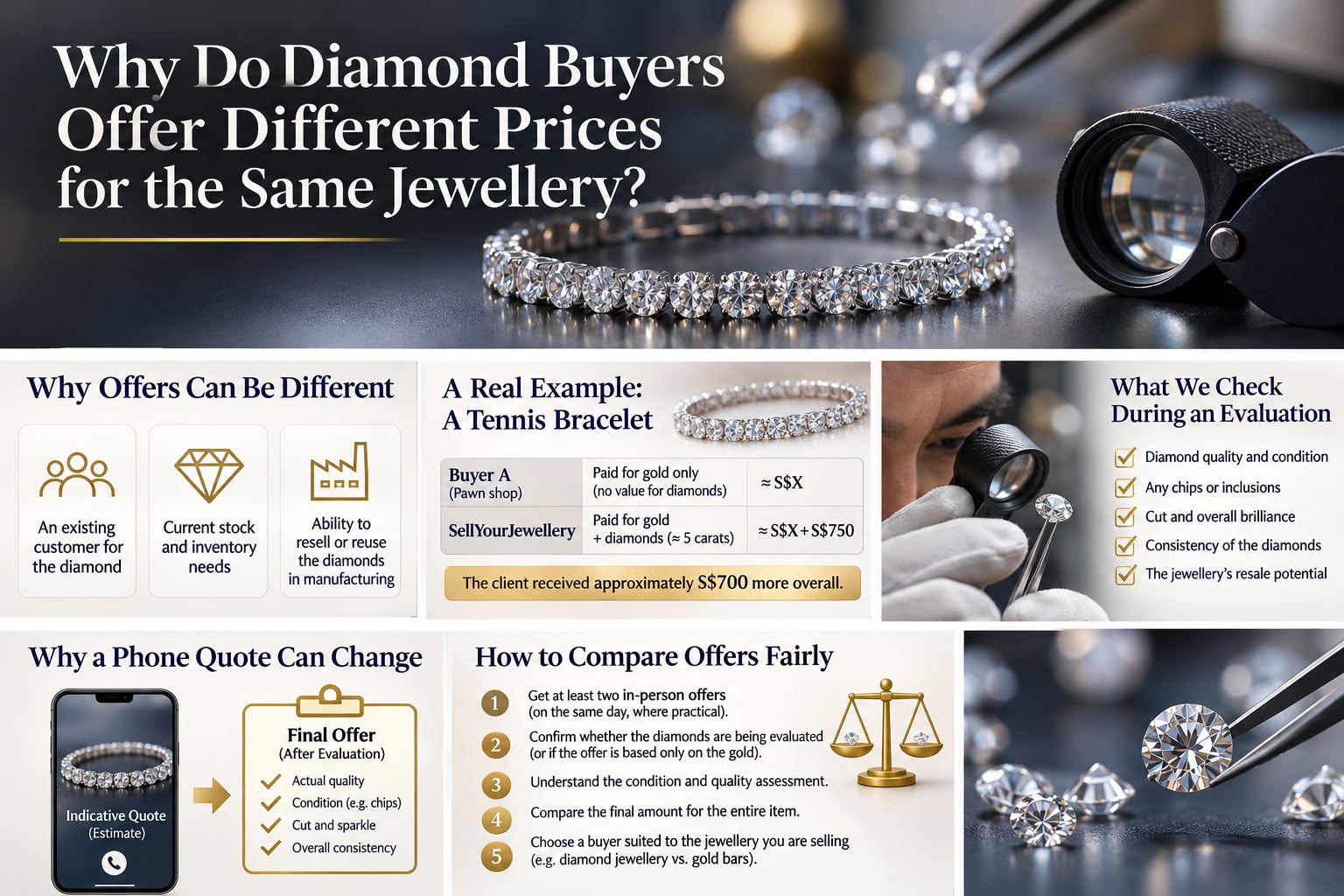
A real example: a tennis bracelet and two different offers
Recently, a customer brought a diamond tennis bracelet to SellYourJewellery after visiting another buyer.
The other buyer offered a slightly higher amount for the gold - approximately SGD $50 more in total—but did not include a payment for the diamonds.
The bracelet contained approximately five carats of diamonds. SellYourJewellery assessed the diamonds and included an amount of approximately SGD $750 for them.
After accounting for the difference in the gold offer, the customer received approximately SGD $700 more overall from SellYourJewellery.
The example shows why the final offer matters more than one individual part of the calculation.
A buyer may pay more per gram for gold but offer nothing for the diamonds. Another may pay slightly less for the gold but include a meaningful amount for the stones.
For the seller, the relevant question is: How much will I receive for the entire item?
Case-study figures are approximate and should be confirmed by SellYourJewellery before publication. The customer’s identity must remain confidential.
Should you compare the gold rate, the diamond value, or the final offer?
We recommend paying close attention to the final offer for the entire item.
A buyer may have an advantage in gold. Another may have an advantage in diamonds. A third may be able to resell the jewellery as a complete piece.
The breakdown can help explain the offer, but the transaction is usually made for the whole item. One part of the calculation does not necessarily tell you which buyer is offering the best overall deal.
For example:
- Buyer A may offer more per gram for the gold but assign no value to the diamonds.
- Buyer B may offer a lower gold rate but include value for the natural diamonds.
- Buyer C may be interested in the piece as finished jewellery and assess it differently.
The customer should compare the final amount they will receive, while making sure each buyer is evaluating the same item and that the offer is clear.
How to compare offers fairly
We recommend that sellers obtain at least two genuine, in-person offers on the same day, where practical.
This allows you to compare offers while the item and market conditions are the same.
When comparing, consider the following:
- Make sure each buyer is evaluating the same jewellery. Include all rings, bracelets, loose stones, and other items in the transaction.
- Ask whether the diamonds are being evaluated. Find out whether the offer is based only on gold or platinum, or whether the diamonds are included.
- Understand the condition and quality assessment. Ask whether any damage, inclusions, or differences in quality affect the offer.
- Compare the final amount. Do not focus only on a gold rate or an estimated diamond value.
- Choose a buyer suited to the item. A specialist in precious metals may be ideal for gold bars, while a diamond jewellery buyer may be better positioned to evaluate a diamond bracelet or ring.
A phone quotation is only an indication until the buyer has examined the actual item. If a quotation changes after inspection, ask what was discovered and how it affected the offer.
The right buyer depends on what you are selling
There is no single buyer who is automatically best for every type of item.
If you are selling gold bars, a buyer who specializes in gold may have a clear advantage.
If you are selling a diamond ring, tennis bracelet, or necklace, the diamonds may form an important part of the item’s value. In that case, it can make sense to choose a buyer who understands natural diamonds, can assess their quality, and has a practical way to resell or reuse them.
At SellYourJewellery, we evaluate jewellery with this wider perspective. We consider the precious metal, the diamonds, and whether the piece or its stones may have resale or manufacturing potential.
Our aim is to make an offer based on the item—not simply on the assumption that all jewellery should be valued as scrap.
Get an in-person evaluation for your diamond jewellery
If you have received different offers for the same jewellery, the next step is to understand what each buyer is actually offering to purchase.
At SellYourJewellery, we evaluate the item as a whole, including its precious metal and natural diamonds where applicable.
We encourage customers to compare genuine in-person offers and choose a buyer whose business model fits the jewellery they are selling.
Bring your jewellery to SellYourJewellery for an evaluation and a clear offer.
FAQ section
Why do diamond buyers offer different prices for the same diamond?
Buyers may have different customers, inventory, resale channels, or manufacturing capabilities. They may also assess the diamond’s condition and quality differently. A buyer with a direct resale opportunity may be able to offer more.
Is the highest gold rate always the best offer?
No. A buyer may offer a higher rate for the gold but not include value for the diamonds. Compare the final amount for the entire item, not only the gold rate.
Can a diamond buyer offer more if they already have a customer?
Yes. If a diamond matches a customer’s request, the buyer may have a more direct resale opportunity. This can make the stone more attractive to that buyer.
Why can a phone quotation change after an evaluation?
A photograph or description may not reveal the diamond’s exact quality or condition. A buyer may discover chips, inclusions, differences in cut, or other characteristics during an in-person examination. The final offer may increase or decrease based on what is found.
Should I get more than one offer before selling diamond jewellery?
We recommend getting at least two genuine in-person offers on the same day where practical. This helps you compare the offers for the same item under similar conditions.
Does SellYourJewellery evaluate diamonds as well as gold?
Yes. SellYourJewellery evaluates the precious metal and natural diamonds where applicable. The offer depends on the characteristics of the jewellery and the diamonds, as well as their resale or manufacturing potential.
Have a similar item to sell?
Receive a non-obligatory cash valuation pegged to live market benchmarks. Message our GIA appraiser directly with your photos or visit our Kreta Ayer showroom.
Sell Your Jewellery Singapore
Official diamond and precious metal buyer in Singapore. Accredited GIA gemologists offering transparent appraisals, spectrometry testing, and immediate PayNow payout.