Whenever gold hits record highs, two powerful instincts immediately collide in the minds of jewelry owners: the fear of selling too early and missing an even bigger surge, and the rush to cash in quickly before prices retreat.
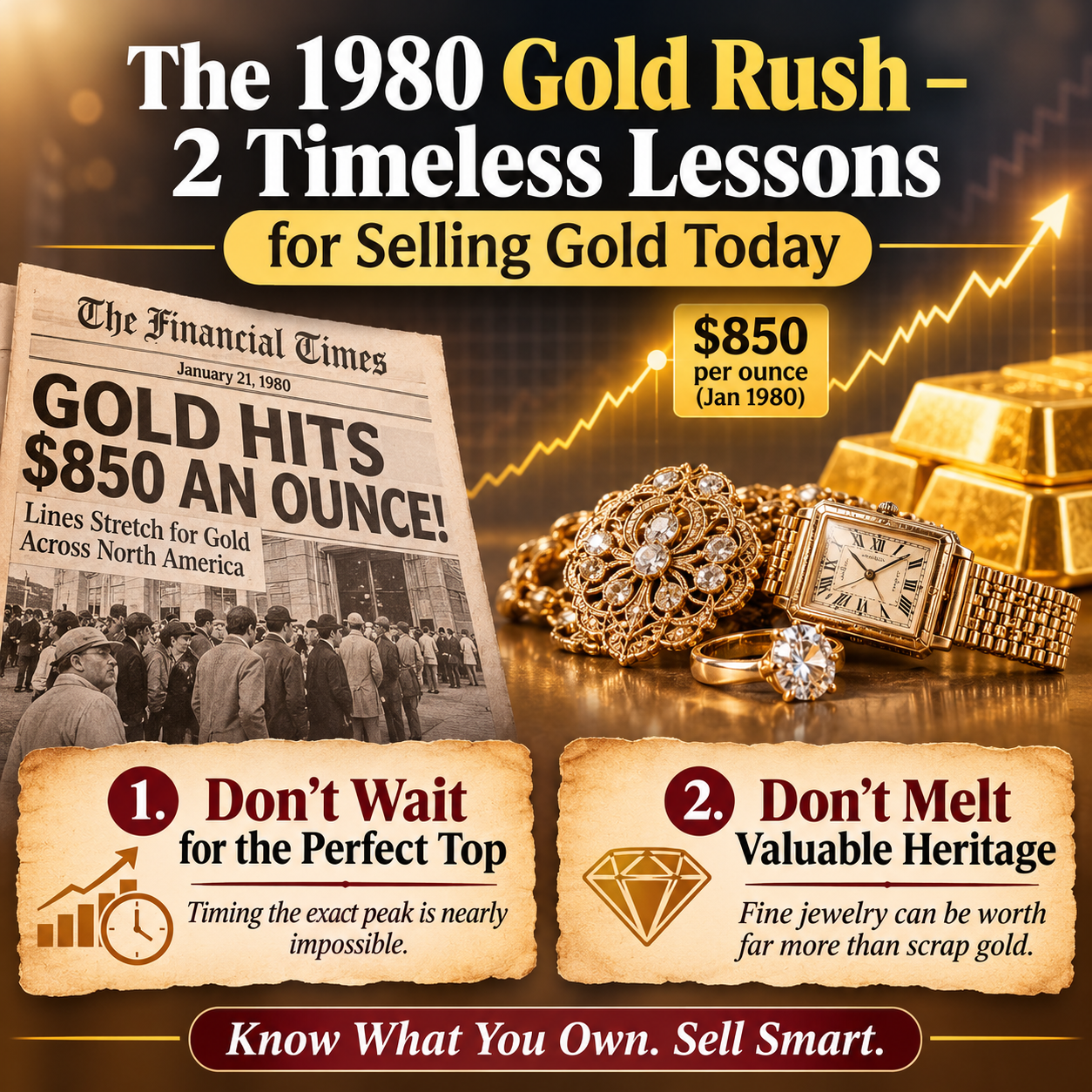
We have seen this exact movie before. In January 1980, gold completed one of the most dramatic rallies in financial history—and triggered a selling frenzy known in the jewelry trade as "The Great Melt." Decades later, what happened during and after that peak offers two timeless lessons for anyone considering selling gold, heirloom pieces, or fine jewelry in today’s elevated market.
From $35 to $850: Anatomy of the 1980 Gold Frenzy
For decades after World War II, gold barely moved. Under the Bretton Woods system, the U.S. dollar was pegged to gold at a fixed $35 per ounce. Everything changed in August 1971, when the United States ended direct dollar-to-gold convertibility, allowing gold to float freely on global markets.
What followed was a perfect storm of macroeconomic anxiety: two major oil shocks, double-digit inflation, eroding confidence in paper currencies, and acute geopolitical crises. Investors and everyday households alike poured into precious metals. By January 1980, gold had skyrocketed more than twentyfold to roughly $850 per ounce (alongside a historic spike in silver).
Outside refineries, pawn shops, and bullion dealers across North America and Europe, lines stretched down the block. Families brought in everything metal they owned—broken chains, wedding bands, pocket watches, heirloom silverware, and antique brooches—eager to turn idle metal into cash at prices nobody had thought possible a decade earlier.
Lesson 1: The 28-Year Hangover (and Why Timing the Exact Top Fails)
Many sellers in late 1979 and early 1980 held back, convinced gold was on a one-way ticket past $1,000 and beyond. Instead, the reversal was swift and brutal.
To crush runaway inflation, Federal Reserve Chairman Paul Volcker aggressively hiked U.S. interest rates toward historic highs. Suddenly, holding cash and bonds offered steep real yields, while gold—which pays no interest—lost its urgency. Gold tumbled sharply from its January 1980 high and entered a grueling multi-decade bear market. It took 28 years—until 2008—for gold to reclaim its nominal $850 peak (and even longer on an inflation-adjusted basis).
Is Today’s Gold Market Identical to 1980?
Not entirely, and the distinction matters. The 1980 peak was driven heavily by late-stage retail euphoria and short-term panic before aggressive monetary tightening broke the rally. Today’s gold cycle is underpinned by deeper structural forces: sustained central bank accumulation, sovereign debt concerns, and long-term reserve diversification away from single-currency risk.
Still, one market law never changes: nobody consistently calls the exact top. Whether gold climbs higher or consolidates next quarter, sellers who evaluate what they actually wear versus what sits untouched in a safe make far better financial decisions than those trying to gamble on the final few percent of a bull run.
Lesson 2: The Tragedy of "The Great Melt"
If waiting too long was one costly mistake of 1980, selling indiscriminately was an even bigger one.
Because scrap prices were so alluring—and because most walk-in buyers at the time operated strictly as weight-based refiners—millions of historic items were tossed straight into the furnace during 1979 and 1980. Georgian rings, Victorian lockets, Edwardian filigree, Art Deco platinum-and-gold bracelets, and signed luxury pieces were dismantled and melted down purely for their raw bullion weight.
In the decades since, the surviving pieces from those eras have become dramatically scarcer. Today, a well-preserved Art Deco piece or a vintage signed bracelet from a major maison can command several times its raw gold melt value on the secondary estate market. The sellers who lined up in 1980 thought they were maximizing their payout; in thousands of cases, they unknowingly destroyed the most valuable part of the piece—its craftsmanship, provenance, and brand heritage.
Melt Value vs. Estate Resale Value: How to Tell the Difference
Before selling any gold item during a market surge, it helps to know which category it falls into:
| Piece Category | Primary Value Driver | Best Selling Approach |
|---|---|---|
| Broken chains, single earrings, outdated mass-market gold | Pure metal weight & karat purity (9K, 14K, 18K, 22K, 24K) | Sell based on transparent live spot pricing and verified purity testing (such as XRF analysis). |
| Signed luxury jewelry (Cartier, Van Cleef & Arpels, Tiffany & Co., Bulgari, etc.) | Brand equity, model desirability, condition, and original box/papers | Never sell for scrap weight. Seek a specialist pre-owned luxury buyer who prices brand premiums. |
| Fine diamond & natural gemstone jewelry | Combined value of the stones (cut, clarity, color, certification) plus the gold mounting | Require a gemologist to evaluate the diamonds or colored stones separately from the metal weight. |
| Rare antique & period pieces (Victorian, Art Deco, mid-century designer) | Craftsmanship, historical period, condition, and collector demand | Request an estate evaluation comparing intrinsic melt value against secondary collector value. |
A Practical Playbook for Selling Gold in a Record Market
History doesn’t repeat word for word, but seller mistakes certainly do. If you are reviewing your jewelry box while gold prices are elevated, four grounded rules protect your upside:
- Separate "scrap" from "estate" before asking for a quote. Broken, bent, or purely generic gold items are ideal candidates to liquidate into a strong gold market. Signed pieces, diamond jewelry, and fine craftsmanship require a specialist—not a scrap-only buyer.
- Insist on non-destructive testing and transparent weighing. Modern professional buyers verify gold karat accurately using X-ray fluorescence (XRF) spectrometers rather than filing into heirloom pieces or guessing purity. You should always see the exact gram weight, karat purity, and calculation clearly explained.
- Evaluate stones independently. During gold booms, scrap buyers often ignore small diamonds or undervalue center stones to focus strictly on metal weight. A qualified gemologist ensures your diamonds, rubies, sapphires, or emeralds are priced on their real market merits.
- Sell in tranches if you are uncertain about timing. Selling doesn't have to be all-or-nothing. Liquidating unworn or broken gold today locks in historically strong prices while letting you hold sentimental or investment-grade pieces without regret.
The 1980 gold rush proved that record prices can be both a rare financial window and an expensive trap. The difference comes down to knowing what you actually own—and making sure a piece of craftsmanship isn't priced like a bar of scrap.
Frequently Asked Questions (FAQ)
What was "The Great Melt" of 1980?
"The Great Melt" refers to the massive wave of gold and silver liquidation in 1979–1980, when gold surged to $850 per ounce and silver spiked near $50. Millions of antique jewelry pieces, vintage watches, and heirloom silverware were sold to scrap dealers and melted down solely for their raw metal weight, permanently reducing the supply of surviving vintage craftsmanship.
How long did it take gold to recover after its 1980 peak?
After hitting roughly $850 per ounce in January 1980, gold fell sharply as U.S. interest rates rose to combat inflation. It did not surpass its nominal $850 record again until 2008—a 28-year gap.
Should I sell my gold jewelry now or wait for prices to go even higher?
Attempting to time the exact peak of any commodity market is notoriously difficult. A practical strategy during historic highs is to sell broken, unworn, or purely generic gold jewelry to lock in strong returns, while keeping pieces you still wear or love—or liquidating in stages if you hold a large collection.
How do I know if my gold jewelry is worth more than its scrap melt value?
Check for maker’s marks, luxury brand signatures (such as Cartier, Van Cleef & Arpels, Bulgari, or Tiffany & Co.), fine natural diamonds or gemstones, and distinctive period craftsmanship (like Art Deco or mid-century designs). Always obtain an assessment from a specialist jewelry buyer and gemologist who evaluates both raw metal weight and secondary estate value before agreeing to sell.
Do gold buyers pay extra for diamonds or gemstones set in old gold jewelry?
Scrap-only gold buyers typically pay only for the gold weight and may offer little or nothing for set stones. Specialist jewelry buyers with in-house gemologists grade the diamonds and gemstones separately and add their market value to the offer alongside the precious metal.
Have a similar item to sell?
Receive a non-obligatory cash valuation pegged to live market benchmarks. Message our GIA appraiser directly with your photos or visit our Kreta Ayer showroom.
Sell Your Jewellery Singapore
Official diamond and precious metal buyer in Singapore. Accredited GIA gemologists offering transparent appraisals, spectrometry testing, and immediate PayNow payout.